
Hair & scalp
Hair treatments
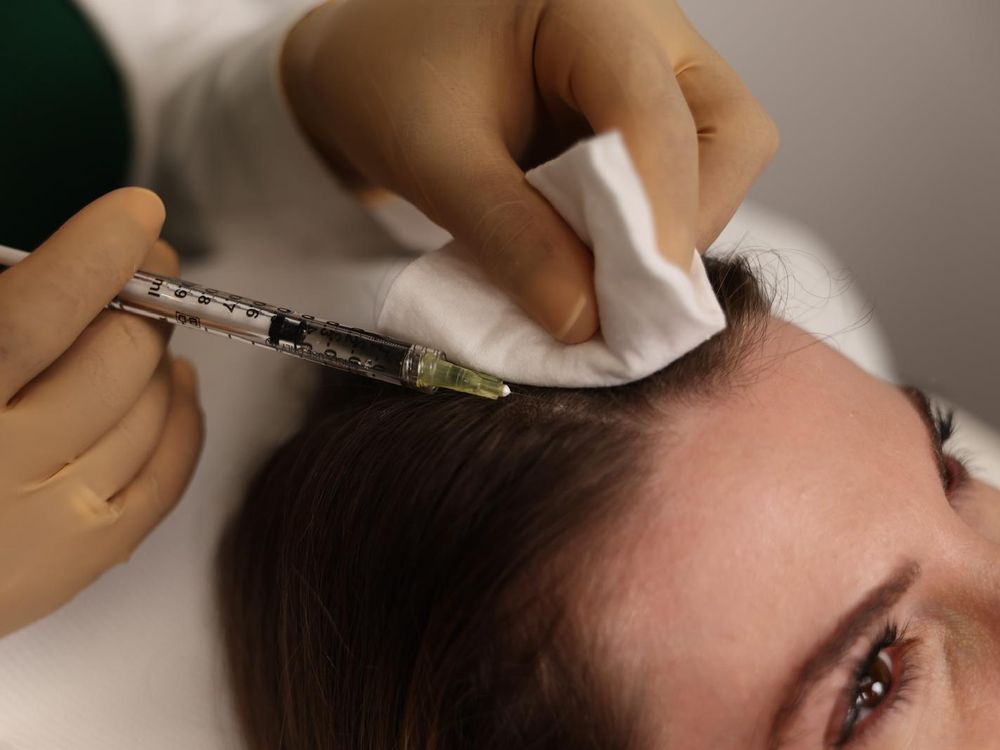
Medical treatments of the scalp — boosters and mesotherapy, topical, oral or injectable treatments — combined according to the assessment in order to slow hair loss and preserve the existing hair.
A graft is not always the first answer. I also offer various medical strategies intended to slow hair loss, to preserve the existing hair and to stimulate the follicles still present.
Depending on the indication and after a search for contraindications, care may combine:
- hair boosters and mesotherapy, by targeted micro-injections at the level of the scalp;
- certain injectable treatments, in particular finasteride-based ones, when their use is medically appropriate;
- protocols combining laser and hair booster, within a strategy of complementary stimulation;
- topical treatments, adapted to the diagnosis and to the scalp;
- oral treatments, when their indication is retained after medical assessment.
The value lies in being able to combine several approaches rather than to offer a standardised treatment, and then in adapting the strategy over the course of the follow-up according to how things develop.
The hair genetic test
In certain situations, I may also offer a hair genetic test (TrichoTest, Fagron laboratory), carried out from a buccal sample.
It analyses certain genetic variants involved in particular in the mechanisms associated with alopecia and in the potential response to different families of active substances. Its purpose is to provide additional information in order to individualise the therapeutic strategy.
It does not, however, replace either the medical examination or trichoscopy: its results are interpreted together with the whole of the clinical assessment.
An approach that is first of all medical
These treatments concern the scalp and the hair; they do not remove the need to look for a cause. Hair loss may stem from a general factor — a deficiency, a hormonal or thyroid disorder, an ongoing treatment, a context of stress, a genetic cause — whose management takes precedence. Depending on the situation, laboratory tests may be requested. Certain forms of hair loss do not fall within the scope of these techniques; others call for a medical treatment, or even for no procedure at all.
After-effects may occur, in particular after injectable procedures: redness, tenderness or tightness of the scalp, oedema or bruising at the puncture points, with a variable course. The other possible adverse effects, as well as the contraindications — in particular those specific to oral prescriptions — are set out before the procedure. A prior consultation is mandatory: it includes a hair assessment, checks for the absence of any contraindication and may conclude that none of these treatments is indicated in the person’s situation.
The graft forms part of an overall strategy
When a graft is envisaged, it therefore forms part of an overall, long-term hair strategy.
My aim is to preserve as far as possible the existing hair and to design the graft while anticipating the future development of the head of hair, with a clear ambition: that ideally a single operation should be necessary over the course of the patient’s life.
This is why medical treatments — topical, oral, injectable or by laser — may be started before the graft and continued after it, in order to protect the native hair and to support the result over time.
Indications
- Hair loss
- Density and quality of the scalp
- Individualised care after assessment
Precautions & aftercare
- A prior consultation is mandatory, with a hair assessment.
- Certain treatments (oral, injectable) require a prescription and carry contraindications of their own, which are set out before the procedure.
- The protocol often involves several sessions; results are gradual and vary from person to person.